


Elements of rhythmic gymnastics

Rhythmic gymnastics is a discipline that combines physical skill with artistic expressiveness. Similar to figure skating or synchronized swimming, it transforms every movement into a mini-performance, where training planning and body control merge into one. The elements of rhythmic gymnastics are not merely technical exercises, but a complex language conveying emotions through expressive poses, jumps, and rotations.
What is meant by the term "elements"?
In the context of this sport, elements of gymnastics refer to a set of movements evaluated by judges according to strict criteria. These include jumps (more than 50 variations), balances, rotations, as well as manipulations with apparatuses such as ribbon, ball, hoop, clubs, and rope. Each action requires not only physical training but also creativity, since routines must combine originality with technical perfection. The difficulty of an element is determined by body position (angles, amplitude) and mastery of the apparatus — these factors influence the scoring.
Basic Elements in Rhythmic Gymnastics
For children beginning their journey in this sport, mastering the basic elements of rhythmic gymnastics becomes a key stage. These elements lay the foundation for future victories by developing flexibility, coordination, and confidence.
Warm-up
Every training session begins with a warm-up — a fundamental element in gymnastics that minimizes the risk of injuries. Exercises include standing on the balls of the feet, bends, squats, and wave-like movements performed smoothly and sequentially.
Warm-up is a mandatory stage of any training and is considered a basic element in gymnastics. Its goal is to prepare the muscles, joints, and ligaments for physical exertion, reducing the risk of injury.
The routine includes sequential exercises performed smoothly and without sudden movements:
1. Bends of the torso and head — increase flexibility of the spine and neck.
2. Squats — activate the muscles of the legs and glutes.
3. Waves with the arms and torso — develop coordination and fluidity.
4. Shoulder rotations — increase joint mobility.
For children, warm-ups are often conducted in a playful manner to actively engage them in the process.
Splits
One of the first skills that young gymnasts master is the splits. Its types (longitudinal, transverse, vertical) require intensive stretching training. Exercises are performed under the guidance of a coach: the girl holds the position while the adult carefully adjusts the angle of the stretch, monitoring the alignment of hips and shoulders. Interestingly, according to research from the Sports Science Institute, regular stretching improves not only flexibility but also mental resilience, reducing stress levels.
Working with Apparatus
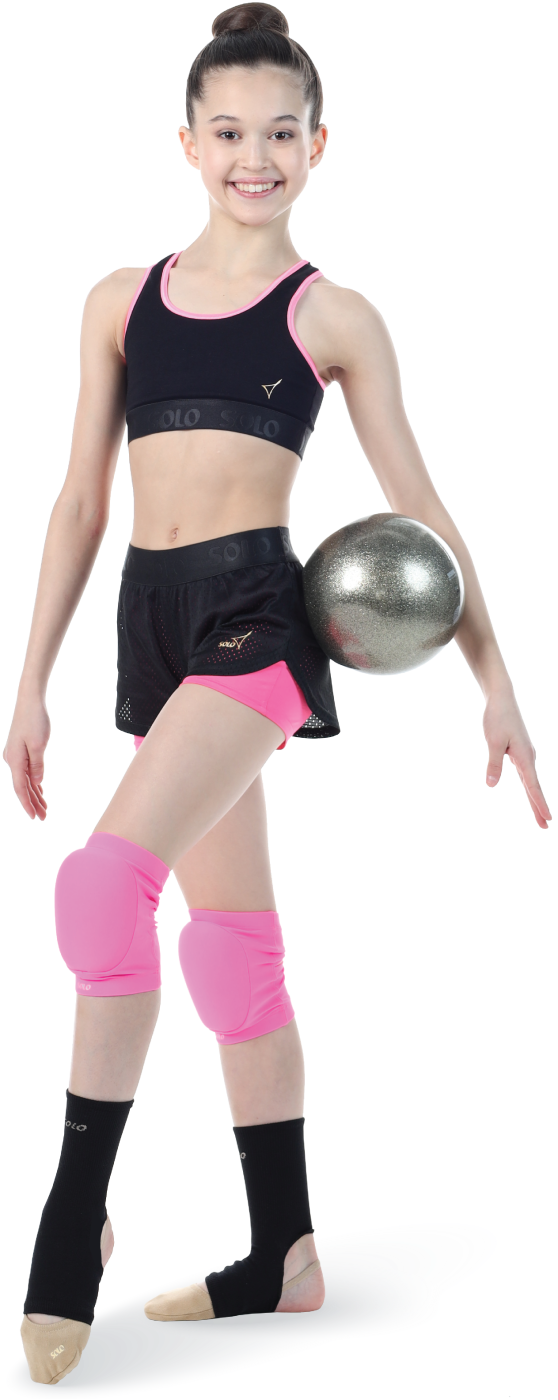
The first months of training are dedicated to familiarizing with the apparatus. For example, ball throws teach how to track the trajectory, while hoop rotations develop originality of movement. Mastering the apparatus is a key stage that forms the skill of synchronizing movements with an external object.
At the beginner level, gymnasts learn to use five apparatuses:
1. Ball — throwing and catching teach trajectory tracking and develop reaction.
2. Hoop — rotations and rolls train spatial control.
3. Ribbon — wave-like movements require effort to maintain smoothness.
4. Clubs — juggling improves motor skills and originality of choreography.
5. Rope — jumping increases endurance and sense of rhythm.
Each apparatus adds variety to the training process, preventing monotony. Ball exercises start with simple rolls on the floor, gradually progressing to throws with a 360° turn. According to statistics, 70% of young gymnasts note that working with apparatus helps them quickly master basic elements such as balances and jumps.
Important! Beginners use lightweight apparatuses: balls made of soft latex, low-weight hoops. This reduces joint strain and allows focusing on technique.
The Fold (Skladочка)
The Fold is one of the fundamental elements in gymnastics that helps young athletes actively develop flexibility in the back and the posterior muscles of the legs.
1. To perform the exercise, the gymnast sits on the floor, stretches her legs forward, and leans toward them, trying to press her stomach fully against her thighs.
2. The hands grasp the heels, and the knees remain stretched tight, like strings.
3. To enhance the effect, coaches recommend using a chair: by placing the feet on it, the girl increases the range of the bend, emphasizing the stretch.
A standing variation requires the legs to be kept together and bending forward until the palms touch the floor. If there is a Swedish wall bar in the gym, the exercise becomes more challenging: the gymnast places one leg on the bar at hip level and reaches toward it while maintaining alignment of the shoulders and pelvis. The Fold is not just stretching; it is a dialogue with one’s own body, where control and relaxation must be balanced.
The Shoulder Stand (Berezka)
The Shoulder Stand, or “Berezka,” is an element that demonstrates core muscle strength and teaches control over the center of gravity. The starting position is lying on the back with legs raised vertically. Supporting the back with the hands, the gymnast lifts the pelvis, holding the body in a static position. At first, the exercise seems difficult, but with experience comes the ability to distribute the load. The Shoulder Stand is a foundation for future complex elements (balances and jumps).
The Forward Roll (Kuvirok)
The Forward Roll is the first skill beginner gymnasts learn. It teaches tucking, proper rolling, and a smooth landing. The starting position is standing with one leg stepped forward. After stepping, the hands go down to the floor, the head is tucked to the chest, and the body rolls over the back. It is important to avoid sharp movements to prevent neck injury. The Forward Roll is the alphabet of gymnastics. Without it, progressing to somersaults or jumps with spins is impossible.
Complex Elements in Rhythmic Gymnastics
Rhythmic gymnastics captivates audiences with its elegance and drama, but behind the apparent ease lie years of training. Among the most spectacular elements are:
Anturnan Jump
The Anturnan jump is a signature move of rhythmic gymnastics, combining technical difficulty with visual impressiveness.
1. To perform it, the gymnast takes a running start.
2. Then, pushing off the support foot, she creates a perfect arch in the air.
3. The legs split at 180° or more, and the head nearly touches the back leg.
This element requires not only ideal flexibility but also the ability to hold the body steady at the moment of maximum amplitude.
The Anturnan jump is one that silences the audience. The Russian Gymnastics Federation awards it 0.8 points, making it one of the most “valuable” elements in the program. Interestingly, even experienced athletes spend up to six months perfecting this move to achieve flawless execution.
Back Balance with Turn
The back balance with turn is an element that demonstrates stability and body control. The gymnast holds one leg vertically while completing a full rotation on the supporting leg, maintaining balance throughout.
The main challenge is synchronizing the rotation with balance control: even the slightest disturbance in the vestibular system leads to loss of position.
This element is a hallmark of professionalism. If executed flawlessly, it means the athlete has reached a high level of technical and psychological preparation.
To master it, gymnasts use special simulators that mimic rotation, helping to build confidence in dynamic conditions.
"Screwdriver" Turn
The "Screwdriver" turn is a spiral rotation resembling the movement of a corkscrew. The gymnast's body twists around its axis, while the arms create smooth lines that emphasize the dynamics. This element often becomes the climax of the performance, as its originality directly affects the judges' scores.
The screwdriver turn is not just a technical maneuver; it is a metaphor for overcoming — you fight inertia but remain graceful. To perfect the turn, gymnasts practice exercises that improve spinal mobility and diversify choreographic sequences.
Straight Leg Extension
The straight leg extension is an element that seems simple only at first glance. The gymnast raises her leg to a vertical position, forming a split, while stretching her arms in the opposite direction, creating a harmonious line. The main goal is to maintain smoothness of movement, avoiding jerks. This element is especially popular among young athletes, as it highlights their natural flexibility. Physiotherapists warn: "Overloading during the execution of the extension can lead to micro-injuries of the ligaments, so it is important to regulate the load." To ensure safe mastery, coaches include exercises to strengthen the pelvic and back muscles in the training program.
Low Ring
The low ring is a combination of balance and rotation, where the gymnast, holding her leg with her hand, forms a closed silhouette. This element requires not only flexibility but also back muscle strength to keep the body in a static position. Mastering the low ring is a pivotal moment in a gymnast’s career. Once an athlete has mastered it, she is ready for more complex routines. To practice this element, resistance bands are used to help maintain the correct positioning of the legs and arms. Interestingly, in 2023, the International Gymnastics Federation increased the difficulty rating of this element, making it even more sought-after in top-level programs.
Conclusion
Rhythmic gymnastics is a symbiosis of effort and intellect, where every element is refined to perfection. For young athletes, it is important not only to train regularly but also to use quality equipment: leotards made from breathable fabrics, professional apparatus (ribbons, balls), and shoes with anti-slip soles. This minimizes the risk of injury and allows full focus on technique.


1 comment